Contents
- 01Key takeaways
- 02On this page
- 03How do I find the serial number and date codes on my Fender amp?
- 04How do I date a Fender amp made after 1990?
- 05How do I date a Fender amp from the 1970s or 1980s?
- 06How do I date a vintage pre-1990 Fender amp without modern stickers?
- 07How do I identify my Fender amp's circuit?
- 08Which original speakers came in each Fender amp model and era?
- 09What were the CBS-era quality control issues (1966-1985)?
- 10What are vintage Fender amp values in 2026?
- 11Detailed dating guides by Fender amp model
- 12Frequently asked questions
- 13Sources and methodology
- 14Related guides
Fender amp dating in one paragraph
For amps built since 1990, read the two-letter date code on the QA inspection sticker on the rear chassis: first letter is year (A=1990, B=1991, continuing through the alphabet), second letter is month (A through L for January through December). For amps built before 1990, the serial number alone is not reliable, because Fender did not keep comprehensive amp-serial records. Cross-reference the tube chart date code (used 1953 to 1969), the EIA transformer date stamps on the bell ends, the speaker date codes on the speaker frames, and the cosmetic features of the chassis and cabinet. The tube chart year-letter system used A=1951, B=1952, continuing through S=1969, then largely disappeared. Always add about six months to the transformer date to account for inventory time between component manufacture and amp assembly. Use Fender’s official serial number lookup tool as a starting reference, then verify with the methodology in this guide.
Key takeaways
- Modern amps (1990 onward). The QA inspection sticker on the rear chassis has a two-letter date code. First letter = year (A=1990, B=1991, continuing), second letter = month (A=January through L=December). This gives you the exact production month.
- Vintage amps (pre-1990). The serial number alone is not reliable. Cross-reference the tube chart date code (1953-1969 system, A=1951 through S=1969), transformer EIA date stamps (606 = Schumacher, the dominant supplier), speaker codes (220=Jensen, 465=Oxford, 137=CTS), and cosmetic era markers.
- The 1970-1989 dark age. Tube chart date stamps largely disappeared after 1969 and modern QA stickers didn’t appear until 1990. Transformer codes plus chassis assembly stamps plus cosmetic era markers are the only reliable evidence. Allow a one- to two-year window rather than expecting precise month-level dating.
- Add six months to transformer dates. Fender’s own service documentation notes that transformers typically sat in factory inventory for several months between manufacture and installation. A transformer dated week 12 of 1965 is often in an amp assembled around week 35 of 1965.
- The OA/OB green-ink anomaly. Tube charts stamped “OA” (January 1966) or “OB” (February 1966) in green ink instead of black are documented factory errors where the year stamper was not advanced from O (1965) to P (1966). These are 1966 amps, not 1965 amps.
- Early silverface (1968-1971) often retains the AB763 circuit. Early silverface amps are essentially blackface amps in different cosmetics and trade at meaningful discounts, often 60-80% of equivalent blackface value while delivering essentially identical tone.
How do I find the serial number and date codes on my Fender amp?
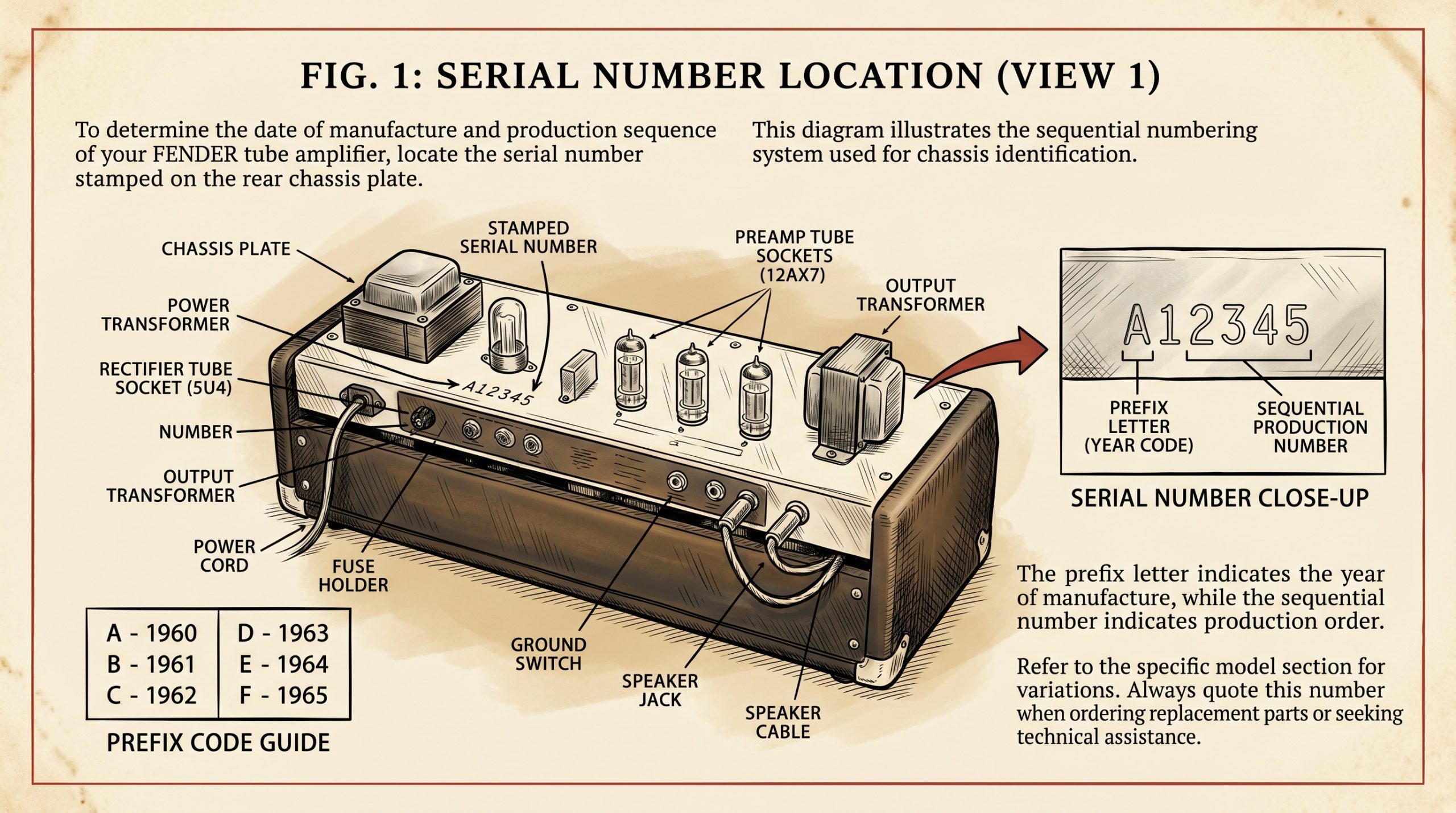
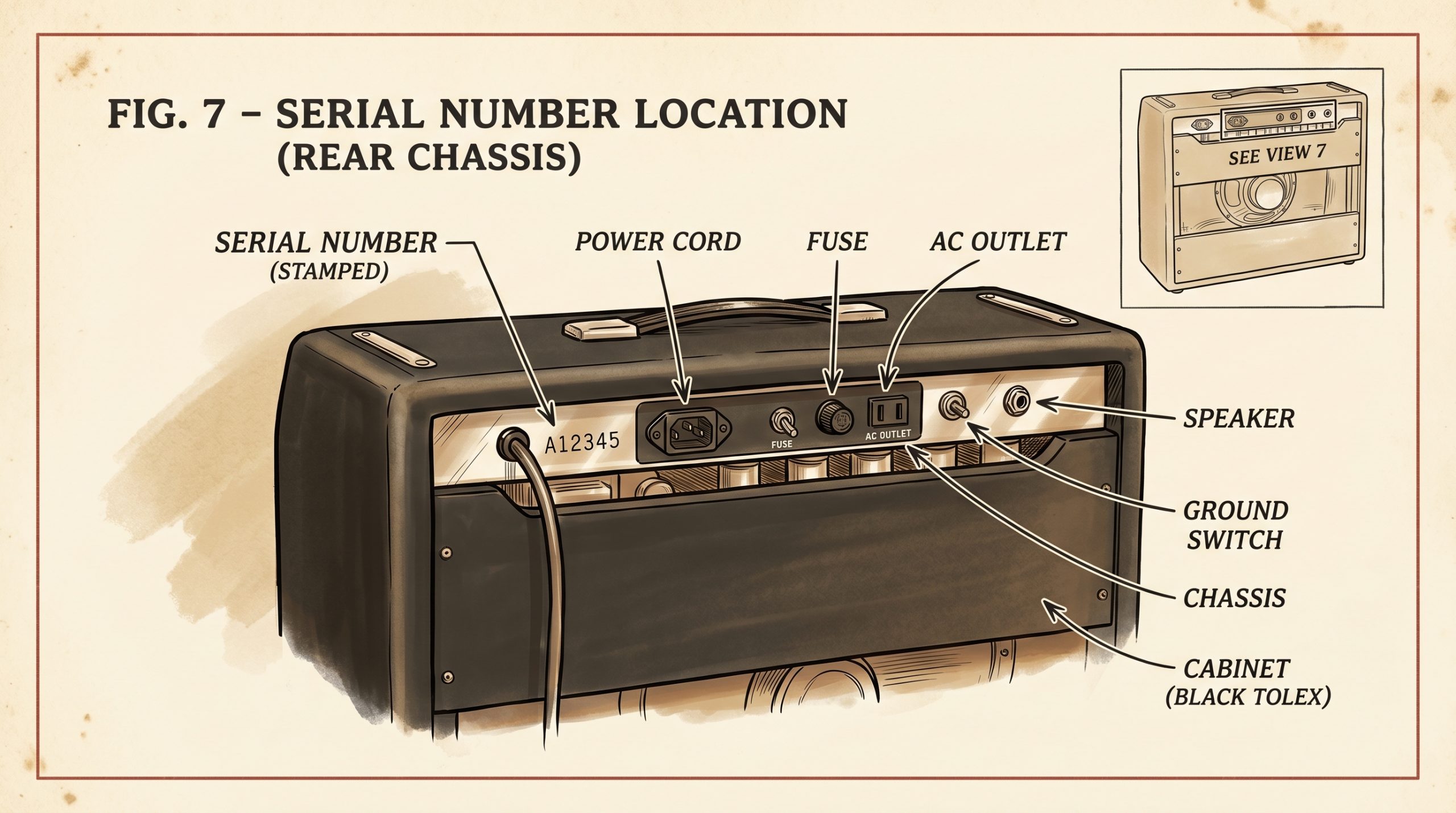
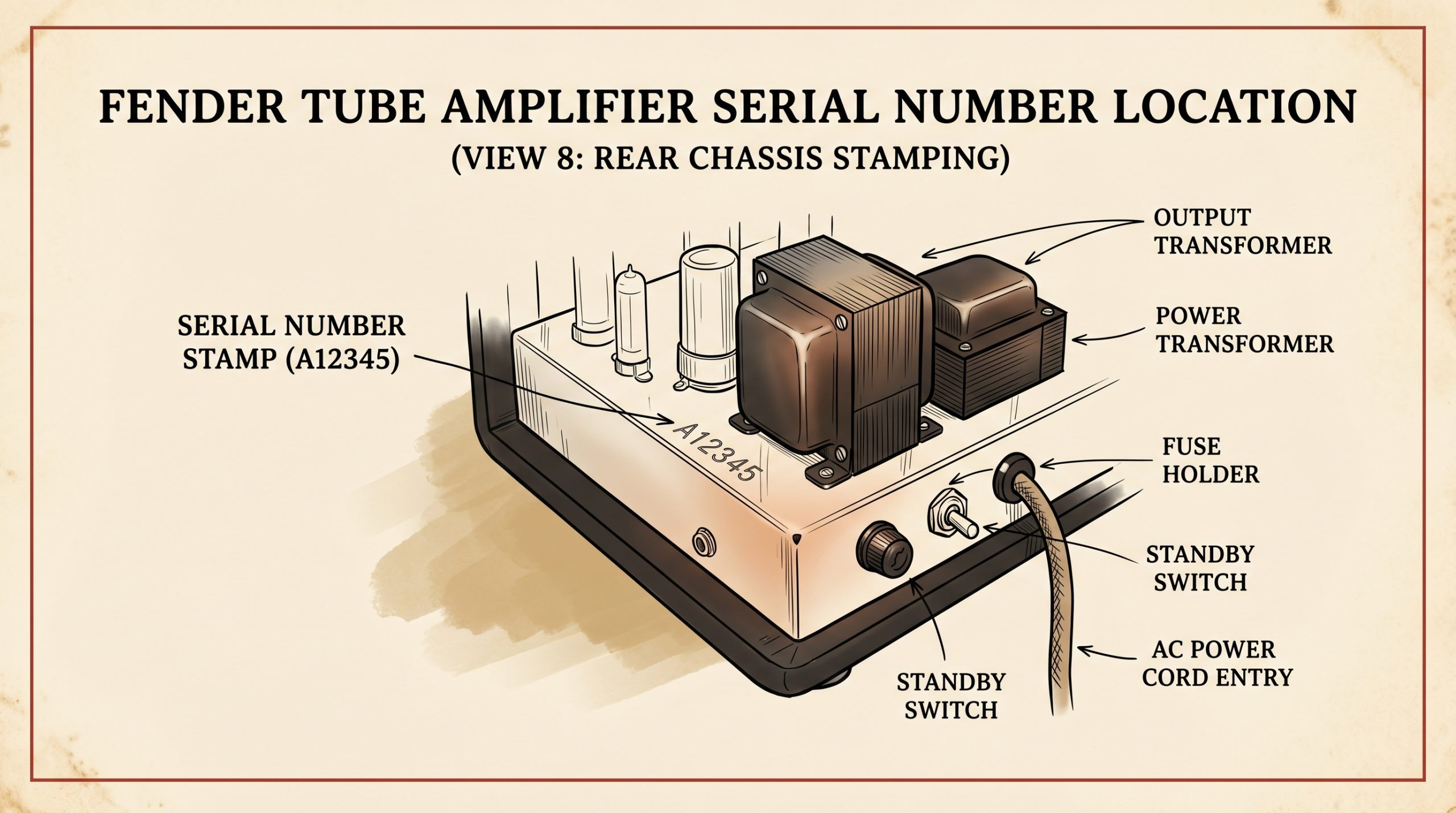
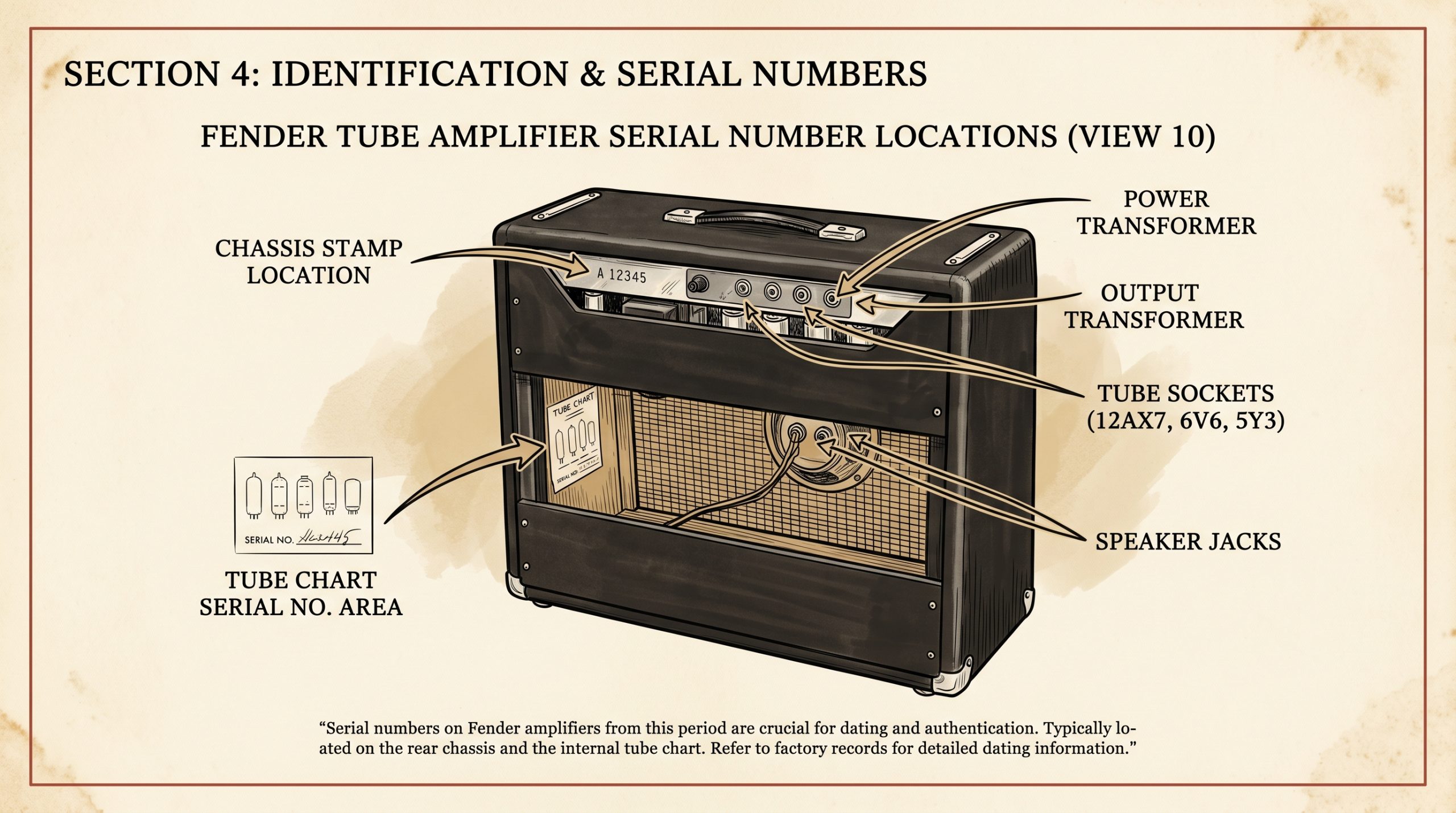
Look in four locations: the tube chart sticker inside the cabinet, the chassis-stamped serial on the rear chassis lip, the transformer bell ends, and the speaker frame stamps. Modern amps (1990 onward) add a black-and-silver QA inspection sticker on the rear panel with a two-letter date code.
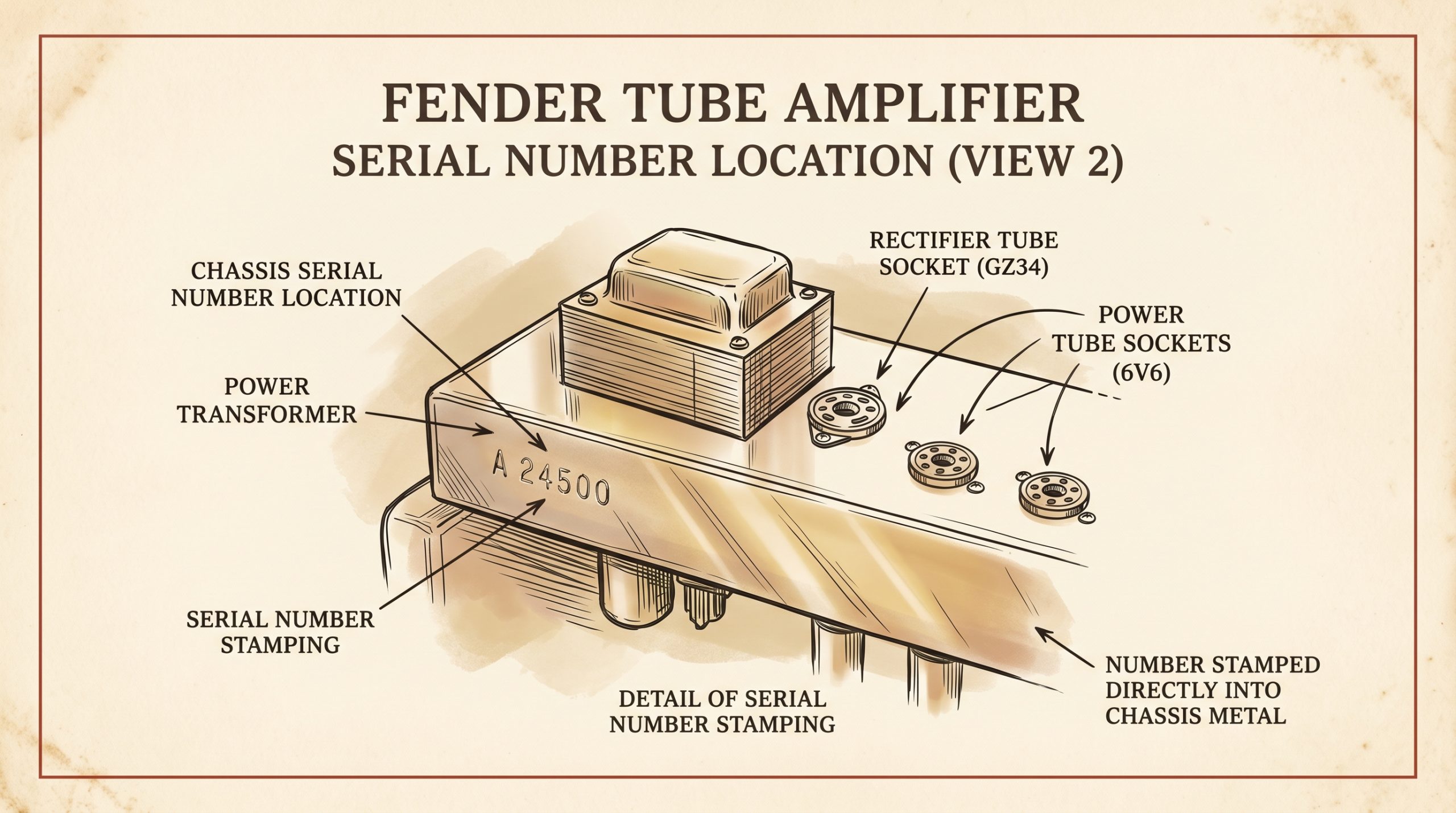
Before you can date a Fender amp, you need to know where to look. Fender’s marking conventions changed almost every time the company restructured its production lines or changed corporate ownership. The location of useful date information depends entirely on when your amp was built, and on whether the cabinet has survived intact with its original paper labels.
Tweed era (1946-1960) chassis
On tweed-era amps, the tube chart sticker is the primary dating reference. It is a small paper label glued to the inside of the cabinet, typically on the back panel above the chassis or inside the bottom panel near the chassis mount.
The sticker shows the model number (such as 5E3 for the Deluxe or 5F1 for the Champ), the schematic revision, and a two-letter date code stamped or rubber-printed in ink. Many tweed-era charts have darkened with age and tobacco smoke to the point of being barely legible. A strong flashlight angled across the surface often reveals what at first looks like a blank label. The chassis itself usually carries no serial number until the late 1950s, when Fender began stamping or hand-writing sequential numbers on the chassis lip near the power transformer. These numbers were model-specific and were not always assigned sequentially, which is why we look first to the tube chart and the component date codes rather than the chassis stamp.
Brown and blonde era (1960-1963) chassis
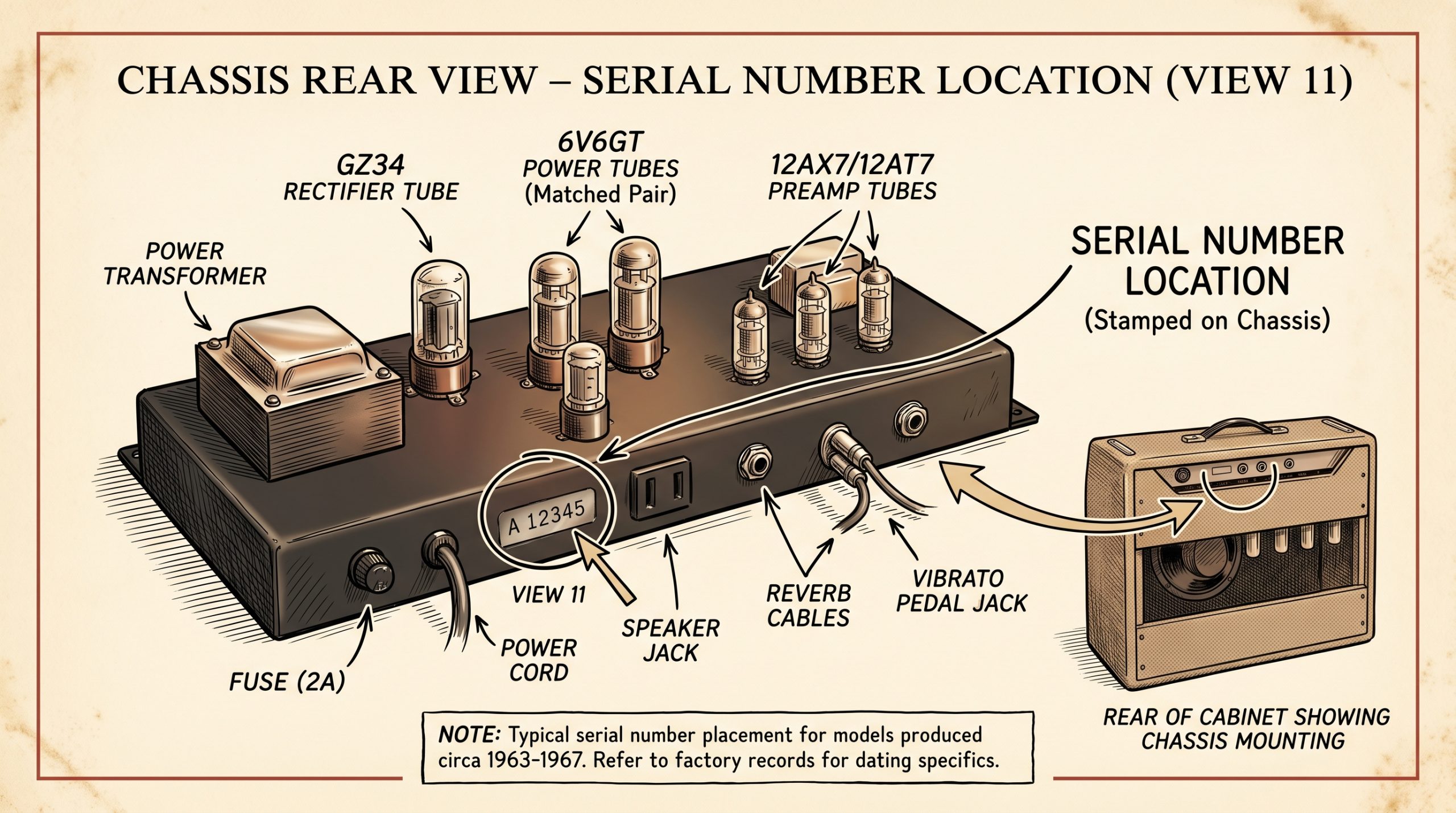
Brown and blonde Tolex amps continued the tube-chart tradition but added more reliable chassis serial numbering. The serial is typically stamped on the rear chassis lip or on a small plate riveted to the chassis.
Tube chart date codes remained in the same two-letter format used in the tweed era. Transformer codes, stamped on the bell ends in a six-digit EIA format that we will decode later in this guide, become a critical cross-reference here, especially when tube charts have been lost during recovering or service. Brown and blonde amps used 6G-prefix circuit designations, which often appear on the tube chart alongside the date code.
Blackface era (1963-1968) chassis
Blackface amps have the most consistent and accessible markings of any pre-modern era. Look for four data points: tube chart sticker, chassis-stamped serial number, transformer EIA codes, and speaker date codes.
Cross-reference these four to confirm originality and date:
- A tube chart sticker on the inside of the cabinet (typically above the chassis or on the back panel) with the model, circuit code, and two-letter date stamp
- A chassis-stamped serial number on the rear chassis lip, usually on the right-hand side when viewed from behind
- Transformer codes stamped or printed on the bell ends of the power transformer, the output transformer, and the reverb transformer (on reverb-equipped amps)
- Speaker date codes ink-stamped or paint-stamped on the speaker frame or bell housing
Cross-referencing all four data points produces a confident date and confirms originality. If the transformer is dated 1965, the speaker is dated 1965, the tube chart is dated 1965, and the chassis stamp falls in the appropriate serial range, you have an original 1965 amp. If the dates spread by a year or more in either direction without a clear reason, you have replacement parts and need to assess what has been changed.
Silverface era (1968-1981) chassis
Early silverface chassis carry stamped serial numbers in the same location as blackface units. However, the tube chart date stamp system effectively ended around 1969-1970, so transformer codes become the most reliable date source for most silverface amps.
From 1970 onward, the most reliable date source on most silverface amps is the transformer code, often cross-referenced against the chassis assembly date stamp. The chassis stamp is a six-digit code (such as T020366 or F034267) that some chassis carry on the underside near the tubes. The first one or two digits indicate the week and the last two indicate the year, with format conventions varying by year. CBS-era inconsistencies mean you may find a 1969 chassis paired with a 1970 transformer and a 1968 speaker. This is not unusual on the assembly line, but worth noting when assessing whether the amp is fully original.
Modern era (1981-present) chassis
From the early 1980s onward Fender adopted a black-and-silver QA inspection sticker applied to the rear panel or chassis. The final line carries a two-letter date code that decodes directly to a production year and month.
The sticker has multiple “sign-off” lines for technicians who completed the sound and electrical tests, with the final line carrying the date code. Modern Fender amps are usually the easiest to date precisely, provided the QA sticker has survived and is legible. If the sticker is missing, the serial number prefix combined with the model itself often allows a date estimate accurate to within a year or two.
How do I date a Fender amp made after 1990?
Read the two-letter date code at the bottom of the QA inspection sticker on the rear chassis. The first letter is the year (A=1990, B=1991, continuing through the alphabet), the second letter is the month (A=January through L=December). For an amp stamped “CE”, the year letter C indicates 1992 and the month letter E indicates May.
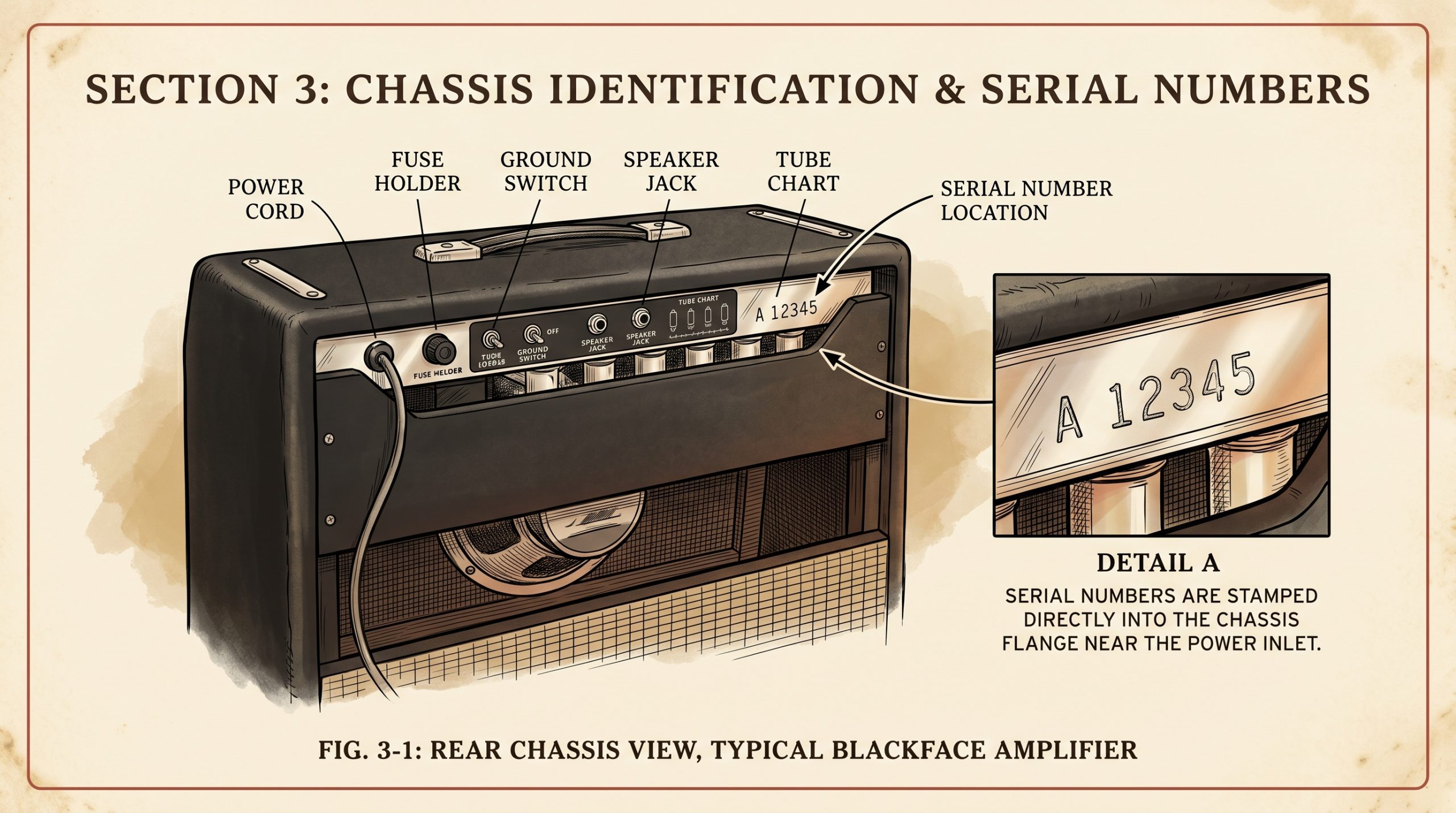
If your amp has a black-and-silver QA sticker on the back of the chassis with a two-letter date code at the bottom, you have a modern Fender amp built since 1990, and you can usually date it to the exact month using the modern letter system. This is the simpler case, and it is where we recommend starting if your amp could plausibly be modern. Most amps that look “new” or “recent” fall into this category, everything from a 1993 ’65 Deluxe Reverb Reissue to a 2024 Tone Master is dated this way.
The modern QA sticker date code system
Per Fender’s official support documentation, every Fender amplifier manufactured from 1990 to the present has a date code printed on the QA sticker. The code is two letters: the first letter indicates the year and the second letter indicates the month. The system began in January 1990 with the prefix AA (year A = 1990, month A = January), and the year letters cycle through the alphabet incrementing by one each calendar year.
Modern QA sticker year-letter reference (1990 to present)
The complete year-letter mapping: A=1990, B=1991, C=1992, D=1993, E=1994, F=1995, G=1996, H=1997, I=1998, J=1999, K=2000, L=2001, M=2002, N=2003, O=2004, P=2005, Q=2006, R=2007, S=2008, T=2009, U=2010, V=2011, continuing through the alphabet.
| Year letter | Year | Year letter | Year |
|---|---|---|---|
| A | 1990 | L | 2001 |
| B | 1991 | M | 2002 |
| C | 1992 | N | 2003 |
| D | 1993 | O | 2004 |
| E | 1994 | P | 2005 |
| F | 1995 | Q | 2006 |
| G | 1996 | R | 2007 |
| H | 1997 | S | 2008 |
| I | 1998 | T | 2009 |
| J | 1999 | U | 2010 |
| K | 2000 | V onward | 2011 onward, continuing through the alphabet |
The month letters use the same A-through-L mapping: A = January, B = February, C = March, D = April, E = May, F = June, G = July, H = August, I = September, J = October, K = November, L = December. The system reset in January 1990 from the original tube chart system that ran through the 1950s and 1960s, so a letter pair like “AH” on a QA sticker means August 1990, while the same “AH” stamp on a 1950s-era tube chart would mean August 1951. Always cross-reference the letter code against the cosmetic era of the amp. The difference between a 1958 tweed Champ and a 1990 Mexican-built amp will be visible at a glance.
What do the letter prefixes on modern Fender amp serial numbers mean?
Letter prefixes indicate production line or factory, not year. CR appears on a wide range of US-built tube amps. M- typically indicates Mexican production (Ensenada). B-, ICE-, and ICF- prefixes generally indicate Asian production. The actual date comes from the two-letter QA sticker code, not the serial prefix.
Some prefixes you will encounter:
- CR: appears on a wide range of US-built tube amps including Hot Rod series and Pro Tube series amps. Often misread as a date code; it is not.
- LO: seen on certain early-2000s amplifier production runs.
- B-, M-, ICE-, ICF-: country-of-origin prefixes. M-prefix indicates Mexican production (typically Ensenada). B-prefix and certain ICE/ICF combinations indicate Asian production, often Indonesian or Chinese.
- PR, T, A, etc.: various US-built and Custom Shop production line prefixes.
Because Fender has not published a comprehensive public chart of every serial-number prefix and the system has evolved over thirty-five years of modern production, the most reliable way to confirm a date on a modern Fender amp is to read the QA sticker date code directly. If the sticker is gone, Fender’s official serial number lookup tool returns a date range based on the serial number, which you can then narrow using any service paperwork that may accompany the amp.
Where are modern Fender amps made?
Hot Rod series and certain budget production lines are built in Ensenada, Mexico. Custom Shop, Vintage Reissue, Pro Tube, and Tone Master amps are built in Corona, California. Some models have been produced in China, Indonesia, and Japan for export markets.
Country prefixes are significant for value and specification. An Ensenada-built Hot Rod Deluxe is not the same product as a Corona-built ’65 Deluxe Reverb Reissue, even when both carry the Fender name. Read the rear-panel sticker and the country-of-origin label carefully. Do not assume the prefix is purely a date code.
How do I date a Fender amp from the 1970s or 1980s?
For amps in this period (roughly 1970 to 1989), tube chart date stamps had largely disappeared and the modern QA sticker did not yet exist. Use transformer date codes (EIA format on the bell ends), chassis assembly date stamps (six-digit codes on the underside), and cosmetic era markers (drip edge, master volume, pull-boost) to triangulate within a one- to two-year window.
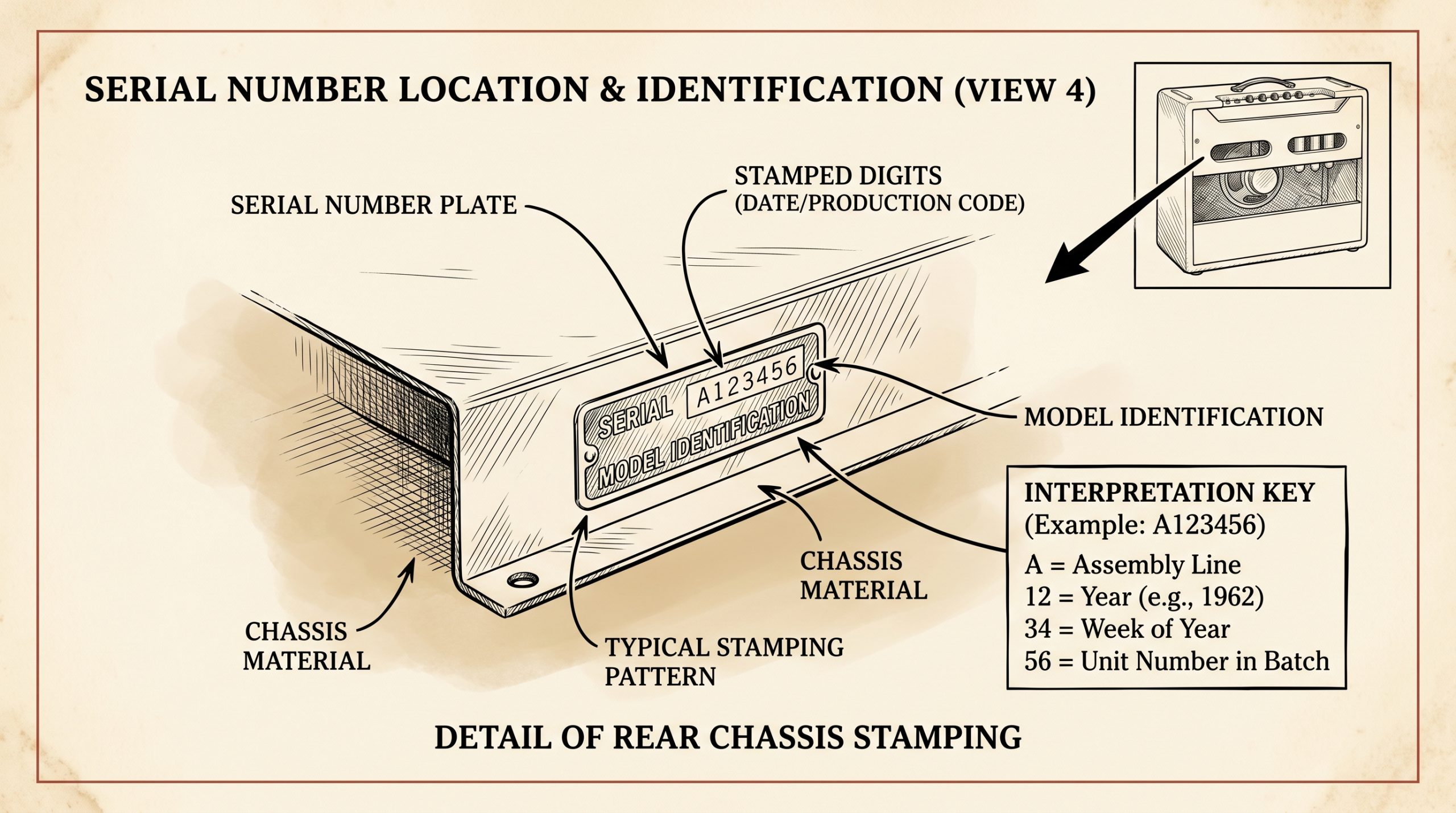
Between the effective end of the tube chart date stamp system around 1969-1970 and the introduction of the modern QA sticker system in 1990, Fender produced amplifiers for roughly two decades with inconsistent or absent factory date marking. Owners of silverface-era Twin Reverbs from the mid-1970s, late-CBS Princeton Reverbs from 1978, post-CBS transitional Bassman amps from the early 1980s, and Rivera-era “II” series amps from 1982 onward all face the same problem: there is no single sticker that gives the year. Dating these amps requires triangulation across multiple component codes and visual era markers.
What makes transformer codes the primary evidence for 1970-1989 amps?
Transformer date codes on the bell ends of the power, output, and reverb transformers become the most reliable date source. Decode the three-digit EIA manufacturer code, then read the year-and-week stamp. Multiple transformers in the same amp should date within a few weeks or months of each other.
For 1970-1989 amps, you rely on these codes as primary rather than as cross-reference. Widely divergent transformer dates indicate replacement parts. Multiple transformers within a single amp should date within a few weeks of each other; substantial gaps suggest something has been replaced during service.
What chassis assembly date stamps appear on 1970s and 1980s Fender amps?
Many 1970s and 1980s silverface and post-CBS chassis carry an ink-stamped or pressure-stamped six-digit code, often on the underside behind the tube row. These typically follow a week-day-year or week-year format that varies by year.
The stamps look like 020366 (week 02, day 03, year 66) or T034267 (T-stamp, week 03, day 42, year 67) where convention varied by year. Reading these requires familiarity with the specific production-era convention. A qualified vintage amp technician will recognize the stamp format at a glance.
What cosmetic era markers help date silverface and post-CBS amps?
Drip edge aluminum grille trim appears 1968-1971. Master volume circuits become standard 1972-1976. Pull-boost circuits and ultra-linear transformers appear 1977-1981. The Rivera-era “II” series (Deluxe Reverb II, Princeton Reverb II, etc.) defines 1982-1985. The Red Knob series defines 1987-1992.
Cosmetic features place an amp into one of several silverface or post-CBS sub-eras with characteristic features:
- 1968-1971 “drip edge” silverface: silver-and-blue control panel with thin black vertical lines, aluminum trim around the grille cloth (the “drip edge”), and AB763-circuit-compatible chassis internals
- 1972-1976 standard silverface: drip edge removed, master volume circuits introduced on some models, AC568 and related CBS-era circuit modifications appear
- 1977-1981 late silverface: pull-boost circuits, ultra-linear output transformer configurations on some Twins, master volume becomes near-universal across the line
- 1982-1985 transition era: Fender exits the CBS era. The “II” series amps (Deluxe Reverb II, Princeton Reverb II, Concert II, Twin Reverb II, Champ II) appear with channel switching and effects loops, designed by Paul Rivera. These are different amps from the originals despite sharing names, and the Rivera-era serial numbers follow their own conventions.
- 1986-1989 post-CBS Schultz era: William Schultz leads the buyout group; production stabilizes; the Princeton Reverb II and certain other models continue while new lines (the Red Knob series, the early “evolution” amps) appear.
How do I date a Rivera-era “II” series Fender amp (1982-1985)?
Rivera-era II amps use F-prefix serial numbers where the digit after F indicates the year: F0=1980, F1=1981, F2=1982-1983, F3=1983-1984, F4=1984-1985. The original 1982-1985 Deluxe Reverb II is a completely different amp than any later model sharing the name.
For amps in this 1970-1989 range, recognizing the cosmetic era first and then triangulating with transformer codes and chassis stamps will reliably place the amp within a one- to two-year window. A working knowledge of which features appeared when (drip edge, master volume, pull-boost, ultra-linear, channel switching, effects loop) lets an experienced restorer date an amp visually before ever touching a component code.
How do I date a vintage pre-1990 Fender amp without modern stickers?
Cross-reference four data points: the tube chart date code (1953-1969 system, A=1951 through S=1969), the transformer EIA date stamps, the speaker date codes, and the cosmetic features. The serial number alone is not reliable for pre-1990 Fender amps because complete amplifier serial records were never maintained.
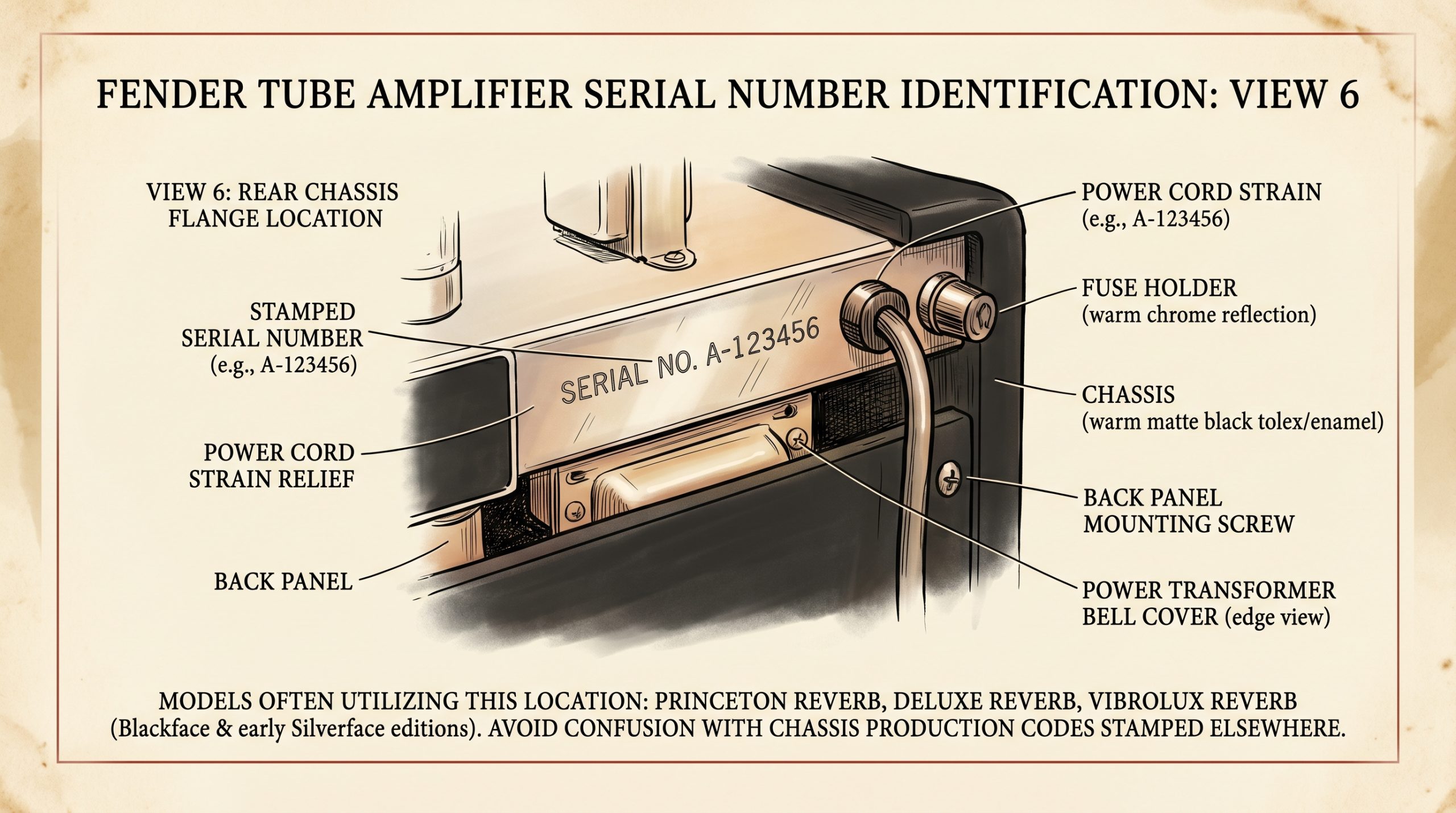
Now we enter the part where amateur internet wisdom often goes wrong and where Greg Gagliano’s original research, conducted with Devin Riebe and Greg Huntington and published in 20th Century Guitar Magazine beginning in 1997, becomes essential. Fender never kept comprehensive serial-number-to-production-date records for amplifiers before the modern era. The company stamped chassis sequentially as units came down the line, but the records linking serial number to assembly date were either never created or were destroyed long ago. This means that the serial number alone on a pre-1990 Fender amp is not a reliable date source.
What is the foundational research behind Fender amp dating?
The community-standard dating methodology comes from Greg Gagliano’s five-part series in 20th Century Guitar Magazine (1997-2000), co-researched with Devin Riebe (tweed era) and Greg Huntington (1960-1967), built from collector contributions including over 250 complete data sets from Fender-specialist technician Jeff Lacio.
In Part 1 of the Gagliano series, the author noted that “Fender amp serial numbers were not always sequential” and that no central database existed. Gagliano, working with Riebe and Huntington, built the first comprehensive cross-reference between serial numbers, tube chart codes, transformer codes, and confirmed production dates. That body of work, refined and expanded through the subsequent four parts of the series, remains the foundation of how the vintage Fender community dates amplifiers today.
What do you need to date a pre-1990 Fender amp?
You need at least three of these five data points: the model and circuit number on the tube chart, the two-letter tube chart date code, the transformer EIA codes, the speaker date codes, and the cosmetic features (control panel script, knob style, grille cloth, Tolex, logo style).
Before you start, gather these data points (you will need at least three of them):
- The model name and circuit number on the tube chart (e.g., “AB763 Deluxe Reverb”)
- The two-letter date code stamped on the tube chart, if present
- The transformer codes stamped on the bell ends of the power transformer, output transformer, and reverb transformer (where applicable)
- The speaker date codes on the speaker frames or bell housings (if the speakers appear original and are not replacements)
- The cosmetic features: control panel labeling, knob style, grille cloth pattern, Tolex color and texture, logo style (with or without tail)
How does the tube chart date code system work (1951-1969)?
From roughly 1953 through 1969, Fender stamped tube charts with a two-letter date code: first letter for year (A=1951, B=1952, continuing through S=1969), second letter for month (A=January through L=December). A chart stamped “OL” decodes as O=1965, L=December, giving December 1965.
The year letters cycled through the alphabet starting with A representing 1951 and advancing one letter per year. The month letters use the same A-through-L mapping with no skips: A = January, B = February, C = March, D = April, E = May, F = June, G = July, H = August, I = September, J = October, K = November, L = December.
The complete year-letter mapping from the tube chart era:
| Year letter | Year | Year letter | Year |
|---|---|---|---|
| A | 1951 | K | 1961 |
| B | 1952 | L | 1962 |
| C | 1953 | M | 1963 |
| D | 1954 | N | 1964 |
| E | 1955 | O | 1965 |
| F | 1956 | P | 1966 |
| G | 1957 | Q | 1967 |
| H | 1958 | R | 1968 |
| I | 1959 | S | 1969 |
| J | 1960 | none | System effectively ends |
A tube chart stamped “OL” decodes as year O = 1965 and month L = December, giving you December 1965. A chart stamped “QH” decodes as Q = 1967 and H = August. A tweed Champ stamped “HH” decodes as H = 1958 and H = August. The system was used most consistently from 1953 onward (Fender produced amps from 1946 but did not establish the stamp convention until 1953) and continued through 1969, after which the date stamp gradually disappeared from production tube charts. By 1970-1971 most Fender amps shipped with unstamped tube charts.
What does the OA or OB stamp on my Fender amp tube chart mean?
OA indicates January 1966. OB indicates February 1966. Both appear in green ink, not the standard black. These are documented factory errors where the year stamper was not advanced from O (1965) to P (1966) when production rolled into January 1966.
To complicate matters further, these mistakenly-stamped amps were also produced in green ink rather than the standard black, which is what alerted the factory to the error. Production caught the mistake in early February 1966 and switched from “O” to “P” and from green ink to black ink. Per Gagliano’s research, the green-ink “OA” and “OB” stamps are confined to January and February 1966 production, and the correct “PA” and “PB” stamps appear from February or March 1966 onward.
These mistakenly-stamped amps are not particularly rare and do not command a premium on their own. They are an interesting factory-error footnote that lets a knowledgeable buyer place the amp’s production to within a six-week window. The correct interpretation requires recognizing both the letter pair and the ink color.
What is the “Division of Colombia Records” misprint on Fender amps?
The Colombia/Columbia misprint is a documented factory error on rear-chassis panels from late 1965 through early 1966 production. The panel reads “Division of Colombia Records” (the South American country spelling) instead of “Division of Columbia Records” (the CBS records label).
How do EIA transformer date codes work on Fender amps?
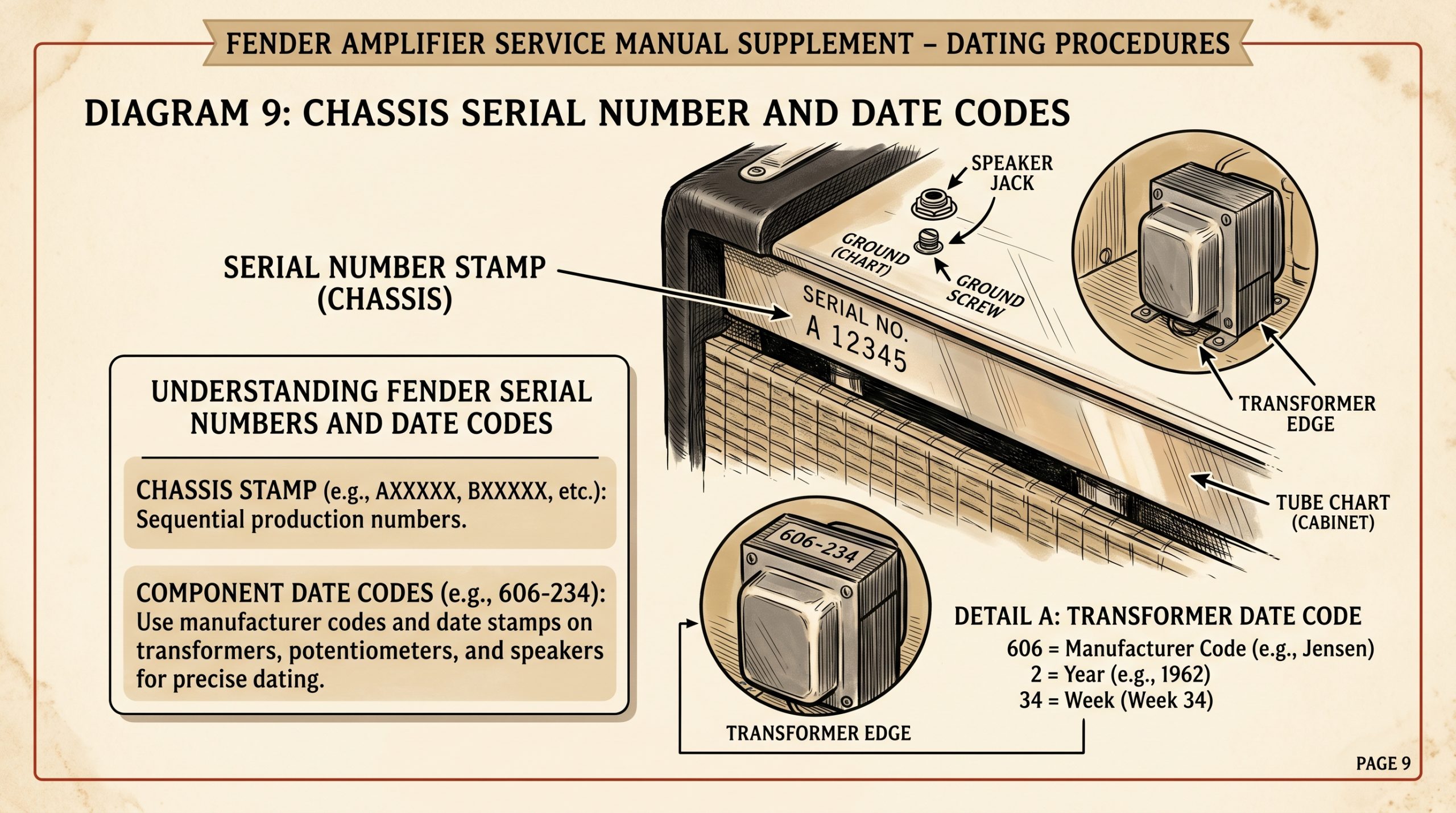
The Electronics Industry Association (EIA) format is a three-digit manufacturer code followed by a date code. 606 = Woodward-Schumacher (the dominant Fender supplier), 022 = Triad, 125 = Stancor. The date encodes year and week, with single-digit years disambiguated by amp era. Add about six months to the transformer date to estimate actual amp production.
When the tube chart is missing, illegible, or appears to be a replacement, transformer date codes become the next best evidence and often the only evidence on post-1969 silverface and post-CBS amps. The Electronics Industry Association (EIA) standardized a source-and-date code format that virtually every American transformer, speaker, and potentiometer manufacturer adopted from the 1950s onward. The format is a three-digit manufacturer code followed by a separator (hyphen or space) and a date code.
For a transformer or speaker stamped, for example, 606-432: the first three digits 606 identify the manufacturer (Woodward-Schumacher, the dominant Fender transformer supplier), and the remaining three digits 4-32 encode the date. Year-digit 4 (either 1964 or 1974, disambiguated by the amp’s era) and week 32 of that year. For a four-digit date code such as 606-6645: the first two digits 66 indicate 1966 and the last two 45 indicate week 45.
EIA manufacturer codes seen on vintage Fender amps
| EIA code | Manufacturer | Component types |
|---|---|---|
| 606 | Woodward-Schumacher (commonly “Schumacher”) | Power, output, and reverb transformers, dominant Fender supplier from 1950s through 1980s |
| 022 | Triad | Transformers, less common on Fender |
| 125 | Stancor | Transformers, occasional appearance |
| 831 | Schumacher (alternate designation) | Some output and reverb transformers in late 1960s production |
| 220 | Jensen | Speakers |
| 465 | Oxford | Speakers |
| 137 | CTS | Speakers, also potentiometers |
| 328 | Utah | Speakers, primarily budget models |
| 67 | Eminence | Speakers, 1970s onward |
| 285 | Rola | Speakers, occasional appearance |
| 391 | Magnavox | Speakers, rare |
| 73 | JBL (James B. Lansing) | Premium speakers, optional upgrade on Twin Reverbs and Showmans |
Reading the EIA date code requires recognizing that single-digit year codes ambiguate by decade. A “5” could mean 1955, 1965, or 1975. Cross-reference against the amp’s cosmetic era to determine the correct decade. A blackface amp with a transformer stamped “606-547” is from week 47 of 1965 (not 1955 or 1975), because the blackface cosmetic era only existed in the 1960s.
How do I tell pre-CBS Fender amps from CBS-era amps?
Pre-CBS amps (before January 5, 1965) carry “Fender Electric Instrument Co.” on the control panel. Post-CBS amps switched to “Fender Musical Instruments” as the parent corporate name changed. The transition was not instant; “Fender Electric Instruments” panels continued through August 1965 due to inventory use-up, and Champ foil stickers continued into 1966.
One of the easiest visual dating clues is the control panel script and the logo style. Pre-CBS examples typically command higher collector premiums due to perceived build quality differences and the cachet of the Leo Fender era.
The script transition happened during 1965 and was not instant. Per Gagliano’s Part 3 research, “Fender Electric Instruments” panels continued to appear on amps assembled as late as August 1965 due to the factory using up existing panel inventory, with the new “Fender Musical Instruments” panels appearing from April 1965 onward.
The Fender grille logo is another era marker. Logos with a tail (a small flourish trailing from the lower right of the script) are from before 1973. After 1973 the logo was tailless. Because Fender used up existing tailed-logo inventory before switching to tailless, you may find 1973-1974 amps with either logo style. Plastic tailless logos on certain 1968 and 1969 Vibro Champs and Bassmans are documented exceptions to the general pattern.
How do I identify my Fender amp’s circuit?
The circuit designation appears on the tube chart sticker. Tweed era circuits use 5-prefix designations (5E3 Deluxe, 5F1 Champ, 5F6-A Bassman). Brown and blonde era uses 6G prefixes (6G3 Deluxe, 6G16 Vibroverb). Blackface era is dominated by AB763 (used in Deluxe Reverb, Twin Reverb, Super Reverb, Pro Reverb, Vibrolux Reverb). Silverface era continued AB763 through 1970, then introduced AC568 and related CBS modifications.
The date code tells you when. The circuit designation tells you what. A 1965 Deluxe Reverb is a “Deluxe Reverb,” but more specifically it is an “AB763 Deluxe Reverb,” and that AB763 designation is what every player and collector actually cares about. Two amps from the same year can have different circuits if Fender revised the design mid-year, and a single circuit designation often spans multiple years and even cosmetic eras. The circuit number is the key to understanding what the amp actually sounds like and what it is worth.
What are the tweed era Fender amp circuits?
Tweed-era circuit designations start with the digit 5 followed by a letter and the model number. Key references: 5E3 Deluxe, 5F1 Champ, 5F6-A Bassman, 5F8-A Twin, 5G9 Tremolux. The first letter denotes revision level (later letters = later revisions).
The famously coveted 5F6-A Bassman from 1958-1960 is the basis of the original Marshall JTM45 and arguably the most influential single Fender amp circuit ever produced. The 5E3 Deluxe and 5F1 Champ are similarly canonical, the recording-studio standard for low-wattage tube amplification.
What are the brown and blonde era Fender amp circuits?
Brown and blonde Tolex amps used 6G-prefix circuit designations. Key references include 6G3 Deluxe, 6G12 Concert, 6G14 Concert revision, 6G16 Vibroverb, and 6G15 Reverb Unit. These circuits often feature unique design elements like bias-modulated tremolo.
Bias-modulated tremolo gives brown-era amps a distinctive throb that neither tweed nor blackface amps replicate. The brown Vibroverb 6G16 from 1963 is among the most collectible Fender amps ever produced, both for its rarity (a single-year production) and for the celebrated tone of the 15-inch Jensen C15N it shipped with.
What is the AB763 blackface circuit?
AB763 is the dominant blackface-era circuit, used in the Deluxe Reverb, Princeton Reverb, Vibrolux Reverb, Super Reverb, Pro Reverb, Twin Reverb, and Bandmaster Reverb. It is the reference voice for clean American electric guitar tone and the design that most modern reissues recreate.
Most blackface Deluxe Reverbs, Princeton Reverbs, Vibrolux Reverbs, Super Reverbs, Pro Reverbs, Twin Reverbs, and Bandmaster Reverbs share the AB763 circuit topology with model-specific component values, tube complements, and speaker configurations. The AB763 is the reference point against which all subsequent Fender circuits are compared and the design that most reissues attempt to recreate.
Important variants within the blackface era:
- AA763: a slightly earlier revision than the AB763, used briefly during the 1963 transition into the blackface line
- AA864 / AA165 / AB165: blackface Bassman circuits (the Bassman uses a different topology than the reverb amps in this era)
- AA964: the blackface Princeton (without reverb), 1963-1967
- AA1164: the blackface Princeton Reverb, introduced 1964
- AB868: appears on some Deluxe Reverbs after 1968, retaining most of the AB763 character
- AA763: the standard non-reverb blackface Twin Amp
The tube chart’s circuit designation tells you exactly which variant you have, provided the chart is original and legible. If the chart is missing, an experienced tech can identify the circuit by visual inspection of the chassis layout, but identifying tweed-era 5-prefix circuits versus blackface-era AB-prefix circuits is generally only reliable with the chart present.
What is the difference between AB763 silverface and AC568 silverface amps?
Early silverface amps (1968 to approximately 1970) often retained the AB763 circuit under the new silver cosmetic panel, essentially blackface amps in different paint. From around 1970 onward, Fender introduced AC568 and related CBS-era circuit revisions with adjustments to bias values, tone stack components, and negative feedback loops. These changes are widely considered tonally inferior to AB763 and can be reversed via “blackface conversion”.
Early silverface amps with retained AB763 are the holy grail of silverface buying: sonically identical to blackface, often available at 60-80% of equivalent blackface value. From approximately 1970 onward, the AC568 changes were made for cost and manufacturing reasons rather than tone improvements, and most vintage-era technicians and players consider them a step backward from the blackface AB763 voice.
Many vintage tech shops will “blackface” a 1970s silverface amp by reverting the AC568 changes to AB763 specifications. This is a reversible modification (if you ever want to restore the amp to AC568 originality, the components are documented and available) and a documented blackface conversion typically adds value rather than reducing it, provided the work is done by a recognized vintage amp technician.
The CBS-era circuit revisions are not uniform across the silverface line. Some models received specific changes while others remained on AB763 specifications longer; the 1980 and 1981 production runs incorporated master volume circuits, pull-boost features, and ultra-linear output transformer configurations that further differentiated specific units. The tube chart, when present, names the circuit directly.
Can a Fender amp’s circuit be identified without the tube chart?
Yes, by visual inspection of the chassis. An experienced vintage amp tech can identify the circuit by component values and layout, particularly bias resistor values, negative feedback loop wiring, and tone stack component values. For valuable amps in the $3,000+ range, a tech assessment is recommended before purchase.
This requires familiarity with the specific model and era. For valuable amps in the $3,000+ range, having a qualified vintage technician confirm the circuit before purchase is a small expense relative to the cost of misidentifying a $5,000 amp as having an original circuit when it has been substantially modified.
Which original speakers came in each Fender amp model and era?
Fender’s primary speaker suppliers were Jensen (EIA code 220) through 1965, then increasingly Oxford (465) through the late 1960s, with CTS (137), Utah (328), Eminence (67), Rola (285), and JBL (73, optional upgrade) appearing through the silverface era. Original speakers in playable condition command meaningful premiums on the vintage market.
Original speakers matter for two reasons: tone and value. A 1965 Deluxe Reverb with its original Jensen C12Q speaker can be worth substantially more than the same amp with a 1980s replacement speaker, and the original speaker contributes meaningfully to the amp’s voice. Knowing which speakers Fender originally fitted helps you assess what you actually have, what to look for if you want to restore originality, and how much the speaker complement should affect your buying or selling decision.
Which speaker brands did Fender use over the years?
Jensen was the primary supplier through tweed and early blackface (1946-1965). Oxford dominated mid-blackface through silverface (1965-1975). JBL appeared as a premium optional upgrade on Twin Reverbs and Showmans. CTS, Utah, Eminence, and Rola filled out silverface and early modern production.
Jensen was Fender’s primary speaker supplier through the tweed and early blackface eras. Jensen models like the P10R, P10Q, P12R, P12Q, C10N, C10R, C12N, C12Q, P15N, and C15N appear on most pre-1965 Fender amps. Jensen production quality declined through the late 1960s (a result of corporate restructuring at Jensen rather than Fender’s choice) and Fender shifted to alternative suppliers as a result. Original Jensen speakers in playable condition command meaningful premiums on the vintage market.
Oxford became a major supplier starting in the early 1960s and dominated mid-to-late blackface and silverface production. Oxford models like the 10J4, 10L5, 12K5, 12L6, 12M6, and 12T6 are commonly found in blackface Deluxe Reverbs, Princeton Reverbs, and silverface units across the line. Oxford speakers have a distinctive voicing (slightly less bright than Jensens, with a fuller midrange) that many players prefer for blackface-era recordings.
JBL appeared as a premium optional speaker on Twin Reverbs, Showmans, Bandmasters, and certain Pro Reverbs from the mid-1960s onward. JBL D120F (12-inch) and D130F (15-inch) speakers are sought-after for their bright, articulate voice with substantial low-end extension. Original JBL-equipped amps command significant premiums over the same models with standard speakers.
CTS, Utah, Eminence, and Rola filled out the silverface and early modern eras. CTS alnico and ceramic speakers appear on many late silverface units, particularly Super Reverbs. Utah was a budget option appearing on student-grade amps. Eminence has been a consistent supplier from the 1970s onward and remains in Fender’s current production lines. Rola speakers appear occasionally on transitional and late-1960s units.
How do I decode a Fender speaker date code?
The format is three-digit manufacturer code followed by three or four digits encoding year and week. A speaker stamped “220-820” decodes as Jensen (220), year-digit 8, week 20, meaning 1958 or 1968 depending on amp era. A four-digit code like “220-6645” indicates 1966 (66), week 45.
All major US speaker manufacturers stamped or paint-stamped date codes on their speaker frames or bell housings using the EIA source-and-date code format. The format is a three-digit manufacturer code followed by three or four digits encoding the year and week of manufacture.
Per Weber Speakers’ reference compilation, the EIA system supports both hyphenated and unhyphenated stamps, and manufacturers occasionally added trailing characters indicating production shift, lot number, or quality-control disposition. The EIA only specifies the manufacturer code and the year-week date; anything beyond those characters is at manufacturer discretion. For dating purposes, focus on the manufacturer code (first three digits) and the year-week stamp.
Original speakers should date within a few months of the rest of the amp’s components. Speakers dated significantly later than the chassis indicate replacement, the speaker was installed during a service or upgrade after original production. The speaker complement on a fully-original vintage Fender amp tells a consistent story: all components date within a window of weeks to a few months around the chassis assembly date.
Speaker reference chart by model and era
The complete original-speaker reference for every major Fender amp model across tweed, brown/blonde, blackface, silverface, and current-production eras. Where multiple speakers appear, Fender used different suppliers at different points within the same production run.
This reference is built on Gagliano’s original speaker chart in Part 5 of the TCG series, expanded and updated with subsequent research from the vintage Fender community and primary documentation from Fender’s archives.
| Model | Era / Configuration | Original speaker(s) |
|---|---|---|
| Bandmaster | Tweed wide panel (1953-1954) | 1× 15″ Jensen P15N |
| Bandmaster | Tweed narrow panel 5E7 / 6G7 (1955-1960) | 3× 10″ Jensen P10R or P10Q |
| Bandmaster | Brown / Blonde 6G7-A (1960-1963) | 1× 12″ Oxford 12M6 or Jensen C12N |
| Bandmaster | Blackface AB763 piggyback (1964-1967) | External 2× 12″ cabinet, Oxford 12T6 or Jensen C12N |
| Bandmaster | Silverface (1968-1974) | External 2× 12″ cabinet, Oxford 12T6 or Utah ceramic |
| Bandmaster Reverb | Silverface (1970-1980) | External cabinet, Oxford or Utah 12″ |
| Bassman | Tweed 5B6 / 5C6 (1952-1954) | 1× 15″ Jensen P15N |
| Bassman | Tweed 5D6 / 5E6-A / 5F6 / 5F6-A (1954-1960) | 4× 10″ Jensen P10R or P10Q |
| Bassman | Brown 6G6 / 6G6-A / 6G6-B piggyback (1960-1963) | 1× 12″ Oxford 12M6 or Jensen C12N |
| Bassman | Blackface AA864 / AA165 piggyback (1964-1967) | 2× 12″ Oxford 12T6 or Jensen C12N (cabinet) |
| Bassman | Silverface (1968-1980) | 2× 12″ Oxford 12T6, Utah, or Rola (cabinet) |
| Bassman 50 / 70 / 100 | Silverface (1972-1980) | External cabinet, Oxford or CTS 12″ |
| Bassman Ten | Silverface (1972-1980) | 4× 10″ CTS ceramic |
| Champ | Tweed 5C1 / 5D1 (1950-1955) | 1× 6″ Cleveland alnico or Jensen P6T |
| Champ | Tweed 5E1 / 5F1 (1955-1964) | 1× 8″ Oxford 8EV, Jensen P8T, or CTS 8″ alnico |
| Champ | Blackface AA764 / silverface (1964-1982) | 1× 8″ Oxford 8EV |
| Champ 12 | Red Knob era (1986-1992) | 1× 12″ Eminence |
| Concert | Brown 5G12 / 6G12 (1960-1963) | 4× 10″ Jensen P10R or P10Q |
| Concert | Brown 6G12-A (1962-1963) | 4× 10″ Jensen P10R, P10Q, or C10R; Oxford 10K5 |
| Concert | Blackface AB763 (1963-1965) | 4× 10″ Oxford 10K5 or 10L5; Utah V10LXC1 |
| Deluxe | Tweed 5B3 / 5C3 / 5D3 (1948-1955) | 1× 12″ Jensen P12R |
| Deluxe | Tweed 5E3 (1955-1960) | 1× 12″ Jensen P12R or P12Q |
| Deluxe | Brown 6G3 (1961-1963) | 1× 12″ Jensen C12N or Oxford 12L6 |
| Deluxe Reverb | Blackface AB763 (1963-1967) | 1× 12″ Jensen C12Q (early) or Oxford 12K5 (later) |
| Deluxe Reverb | Silverface (1968-1981) | 1× 12″ Oxford 12T6, CTS, or Utah |
| Deluxe Reverb ’65 Reissue | 1993-present | 1× 12″ Jensen C-12K (ceramic, reissue spec) |
| ’64 Custom Deluxe Reverb | 2018-present | 1× 12″ Jensen C-12Q (alnico reissue) |
| ’68 Custom Deluxe Reverb | 2013-present | 1× 12″ Celestion G12V-70 |
| Tone Master Deluxe Reverb | 2019-present | 1× 12″ Jensen N-12K (custom-spec for digital amp) |
| Harvard | Tweed 5F10 / 6G10 (1955-1963) | 1× 10″ Jensen P10R |
| Musicmaster Bass | Silverface (1970-1980) | 1× 12″ Oxford or CTS |
| Princeton | Tweed 5F2 / 5F2-A (1956-1961) | 1× 8″ Jensen P8T or Oxford |
| Princeton | Brown 6G2 (1961-1963) | 1× 10″ Jensen C10R or Oxford 10J4 |
| Princeton | Blackface AA964 (1963-1967) | 1× 10″ Oxford 10J4 or Jensen C10R |
| Princeton Reverb | Blackface AA1164 (1964-1967) | 1× 10″ Oxford 10J4 or Jensen C10R |
| Princeton Reverb | Silverface (1968-1982) | 1× 10″ Oxford 10L5 or CTS |
| ’64 Custom Princeton Reverb | 2020-present (AA1164 circuit) | 1× 10″ Jensen P10R alnico |
| Princeton Reverb ’65 Reissue | 2008-present | 1× 10″ Jensen C-10R reissue |
| Pro | Tweed 5E5 / 5E5-A (1955-1960) | 1× 15″ Jensen P15N |
| Pro Reverb | Blackface AB763 (1965-1967) | 2× 12″ Jensen C12N or Oxford 12L6 |
| Pro Reverb | Silverface (1968-1980) | 2× 12″ Oxford 12T6, CTS, or Utah |
| Showman | Blonde / Blackface (1961-1969) | External cabinet, 1× 15″ or 2× 15″ JBL D130F or Jensen C15N |
| Showman | Silverface (1969-1980) | External cabinet, JBL D130F or Oxford 15″ |
| Super | Tweed 5C4 / 5D4 / 5E4 (1952-1960) | 2× 10″ Jensen P10R |
| Super | Tweed 5F4 (1958-1960) | 2× 10″ Jensen P10R |
| Super Reverb | Blackface AB763 (1963-1967) | 4× 10″ Jensen P10R, CTS alnico, or Oxford 10L5 |
| Super Reverb | Silverface (1968-1981) | 4× 10″ CTS alnico or Oxford 10T6 |
| Tremolux | Brown 6G9 / 6G9-A / 6G9-B (1961-1963) | 2× 10″ Jensen P10R |
| Tremolux | Blackface AA763 / AB763 piggyback (1963-1966) | 2× 10″ Jensen P10R cabinet |
| Twin | Tweed wide panel 5C8 (1952-1953) | 2× 12″ Jensen P12R |
| Twin | Tweed 5E8-A / 5F8-A (1955-1960) | 2× 12″ Jensen P12N |
| Twin | Brown / Blonde 6G8 / 6G8-A (1960-1963) | 2× 12″ Oxford 12M6 or Jensen C12N |
| Twin Reverb | Blackface AB763 (1963-1967) | 2× 12″ Jensen C12N, JBL D120F optional |
| Twin Reverb | Silverface (1968-1981) | 2× 12″ Oxford 12T6, JBL D120F optional, Utah late |
| Twin Reverb ’65 Reissue | 1991-present | 2× 12″ Jensen C-12K reissue |
| Tone Master Twin Reverb | 2020-present | 2× 12″ Jensen N-12K (custom-spec for digital amp) |
| Vibrasonic | Brown / Blonde 5G13 / 6G13 (1959-1963) | 1× 15″ JBL D130F or Jensen C15N |
| Vibro Champ | Blackface AA764 / silverface (1964-1982) | 1× 8″ Oxford 8EV or Eminence |
| ’68 Custom Vibro Champ | Reissue era | 1× 10″ Celestion Ten 30 |
| Vibrolux | Brown 5G11 / 6G11 / 6G11-A (1959-1963) | 1× 12″ Jensen P12N or C12N |
| Vibrolux Reverb | Blackface AB763 (1964-1967) | 2× 10″ Jensen C10N or Oxford 10L5 |
| Vibrolux Reverb | Silverface (1968-1981) | 2× 10″ Oxford 10L5, CTS, or Utah |
| Vibroverb | Brown 6G16 (1963 only) | 1× 15″ Jensen C15N |
| Vibroverb | Blackface AB763 (1964 only) | 2× 10″ Jensen P10Q |
| Vibroverb ’63 Reissue | 1990-1995 | 1× 15″ Jensen C15N reissue |
How does speaker replacement or reconing affect Fender amp value?
Original speakers in playable condition command meaningful premiums. A reconed original (frame and magnet original, cone replaced by a professional shop) falls between fully-original and replacement in value. Outright replacement speakers reduce vintage value 15-30% depending on the amp and replacement type.
A reconed speaker is mechanically equivalent to a new one in many ways but loses the originality premium for the cone assembly itself. The frame and magnet remain original, so a documented professional recone by a recognized shop (Weber, Orange County Speaker, others) preserves more value than a less-traceable repair.
Honest sellers disclose recone status. Visual indicators include obvious rework around the surround glue line, a dust cap that looks freshly attached, or a cone that appears noticeably newer than the speaker frame. If you are buying a vintage Fender amp and the speakers are critical to your purchase decision, ask the seller directly whether the speakers have been reconed and whether any documentation accompanies the work.
Outright replacement speakers (Weber 12A150, Eminence Maverick, Celestion Vintage 30, Jensen reissues, or other modern aftermarket options) change the amp’s voice substantially and reduce vintage market value. If you want a different sound, keep the original speaker stored separately and reinstall it before selling. The amp can always be re-converted to its original speaker complement; what cannot be restored is a lost original speaker.
What were the CBS-era quality control issues (1966-1985)?
Quality declined gradually through the late 1960s and 1970s, reaching a low point around 1979-1980. Documented issues include the 1972-1974 humming Princeton Reverbs (missing heater ground resistors), incorrectly wired silverface tremolo circuits, and progressive component-substitution cost-cutting. Early CBS years (1965-1967) were mostly fine; problems accumulated through the mid-1970s.
Fender was sold to CBS in January 1965. Long-time Fender owners and players will tell you that quality declined immediately and steadily through the late 1960s and 1970s, reaching a low point around 1979-1980 before Bill Schultz’s leadership team began the recovery that culminated in the post-1985 buyout era. The reality is more nuanced than the cartoon version, but the broad pattern is real, and there are specific things to watch for when shopping CBS-era amps.
How are early CBS-era amps (1965-1967) different from pre-CBS amps?
Functionally, they are not different. Early CBS-era amps (1965-1967) often used leftover pre-CBS parts inventory and were assembled by the same workers on the same workbenches. A 1966 Deluxe Reverb with AB763 tube chart, original Schumacher transformers, and original Jensen speakers is the same amp as a 1964 unit in every meaningful sense.
The “CBS killed Fender” narrative oversimplifies what happened; the immediate transition years saw the same workers, same suppliers, and largely the same designs continue under new ownership. Don’t write off early CBS-era automatically. Look at what specifically is in the box.
What documented factory errors exist from the CBS transition era?
Four documented factory errors define the CBS transition: the OA/OB green-ink tube chart anomaly (Jan-Feb 1966), the Colombia/Columbia rear-panel misprint (1965-1966), the 1972-1974 humming Princeton Reverbs (missing heater ground resistors), and incorrectly wired silverface tremolo circuits on certain early-1970s Twin Reverbs.
Adjacent to the OA/OB tube chart anomaly and the Colombia/Columbia misprint covered earlier, several other documented factory errors mark this transitional period:
- The 1972-1974 humming Princeton Reverbs: as covered above, missing heater ground resistors caused unresolvable hum until installed correctly
- Incorrectly wired silverface tremolo circuits: some silverface Twin Reverbs from the early 1970s shipped with incorrect resistor values in the tremolo circuit, producing a sluggish, weak vibrato effect compared to blackface units. This is identifiable by ear and correctable by a vintage tech with the correct schematic in hand.
- Component substitution shortcuts: from approximately 1968 onward, CBS-era manufacturing introduced cost-saving component substitutions that affected tone. Watch for parallel ceramic caps replacing higher-quality film capacitors in tone-stack positions; chocolate-drop disc capacitors in coupling positions where Mylar or paper-in-oil had been standard; lower-quality transformer steel appearing intermittently on early-1970s output transformers. These changes are not modifications. The amps left the factory with these components, but they are commonly addressed by vintage techs during restoration work to restore the pre-CBS tonal character.
What happened to Fender amp quality in the 1980 nadir and the Rivera “II” series?
By 1979-1980, Fender amplifier quality and design coherence had degraded substantially. The Paul Rivera-designed “II” series amps (1982-1985) attempted a recovery within CBS by introducing channel switching, effects loops, and circuit revisions across the line. Tonally controversial, but technically more sophisticated than their predecessors.
The Deluxe Reverb II, Princeton Reverb II, Twin Reverb II, Champ II, Concert II, and Super Champ are all from this era. The Rivera amps are technically more sophisticated than their plain-name predecessors but tonally controversial; players who want the classic Fender voice generally prefer pre-Rivera amps. The current Deluxe Reverb II is a separate, modern amp unrelated to the 1982-1985 Rivera-era model that shared the name.
How did Fender amp quality recover under William Schultz (1985 onward)?
William Schultz led the buyout group that acquired Fender from CBS in March 1985. Production gradually rebuilt with vintage-respectful designs, culminating in the Vintage Reissue series (1991 onward) bringing back the ’65 Twin Reverb, ’65 Deluxe Reverb, ’63 Vibroverb, and other staples.
The 1985-1990 period saw substantial production disruption and inconsistent quality as facilities and suppliers were rebuilt, so amps from this transitional window deserve more scrutiny than either earlier CBS-era amps or post-1991 reissue production.
What are vintage Fender amp values in 2026?
Tweed era amps range from $2,000 (Champ) to $25,000 (5F8-A Twin). Brown/blonde era amps range from $2,000 to $20,000 (1963 Vibroverb). Blackface amps range from $1,500 (Princeton) to $7,000 (Deluxe Reverb with original Jensen). Silverface amps range from $400 to $4,000 depending on era and originality. All ranges reflect good-to-excellent condition with documented originality.
Fender amp values move with the broader vintage gear market and have generally trended upward over the past two decades, with periodic corrections. The ranges below reflect 2026 retail prices for amps in good-to-excellent condition with original major components (chassis, transformers, original speakers, original Tolex, working condition). Mint-condition examples with complete documentation, original cover, and pristine cosmetics can command 25-40% above these ranges. Project-grade amps with significant non-original parts, re-cover, or non-functional condition trade at 30-50% below.
Always cross-reference recent Reverb completed-sales listings before buying or selling. The vintage Fender market moves enough that any printed range is a snapshot, and specific models with low transaction volume (rare years, unusual configurations) may show wider price dispersion than these summary numbers suggest.
What drives vintage Fender amp value the most?
Four factors in order of importance: originality of major components (chassis, transformers, original speakers), cosmetic condition (original Tolex, original grille cloth, original handle), working condition (recently serviced, caps replaced, properly biased), and documentation/provenance.
- Originality of major components: chassis, transformers, original factory-installed speakers, tube chart, and rear-panel ID plate. The original speaker complement specifically affects value substantially. A blackface Deluxe Reverb with its original Jensen C12Q is worth more than the same amp with a replacement speaker, even a high-quality reissue.
- Cosmetic condition: original Tolex without re-cover, original grille cloth (which is delicate and often deteriorated), original handle, original knobs, original Fender logo with appropriate tail/tailless style for the era.
- Working condition: recently serviced, electrolytic capacitors replaced, tubes biased correctly, no hum or noise issues, all original-style components in service. A serviced vintage amp is worth several hundred dollars more than an unserviced equivalent.
- Documentation and provenance: original receipts, service history, original owner identification, or provenance from a notable previous owner. Particularly relevant on high-end pre-CBS examples.
Tweed era originals (2026 market ranges)
- Tweed Champ 5E1 / 5F1: $2,000-4,000 in good condition; mint with all-original parts can reach $5,500
- Tweed Deluxe 5E3: $4,000-8,000; pristine examples with original Jensen P12Q reach $10,000+
- Tweed Princeton 5F2-A: $2,500-4,500
- Tweed Bassman 5F6-A (1958-1960): $8,000-18,000; documented original examples in excellent condition reach $25,000
- Tweed Twin 5F8-A: $12,000-25,000 for clean originals
- Tweed Super 5F4: $4,500-8,000
Brown and blonde era originals
- Brown Deluxe 6G3: $3,000-6,000
- Brown Princeton 6G2: $2,000-3,500
- Brown / Blonde Bandmaster 6G7-A: $4,000-8,000
- Brown Concert 6G12: $3,500-6,500
- Brown Vibroverb 6G16 (1963 only): $10,000-20,000 depending on condition; this single-year model is among the most collectible Fenders ever made
- Brown Vibrolux 6G11: $2,800-5,000
Blackface era originals
- Blackface Princeton Reverb (1964-1967): $1,800-3,500; pre-CBS 1964 examples with documented originality reach $4,500
- Blackface Princeton non-reverb AA964: $1,500-2,800
- Blackface Deluxe Reverb (1963-1967): $3,500-6,000; premium 1965-1966 examples with original Jensen C12Q reach $7,000+
- Blackface Vibrolux Reverb (1964-1967): $2,000-4,000
- Blackface Super Reverb (1963-1967): $2,500-5,500
- Blackface Twin Reverb (1963-1967): $2,500-5,000; JBL-equipped examples add $1,000-2,000
- Blackface Pro Reverb (1965-1967): $2,200-4,200
- Blackface Bassman AA864 / AA165: $2,000-4,000 (head plus cabinet)
- Blackface Showman with JBL cabinet: $2,500-5,500
Silverface era originals
- Early silverface 1968-1971 with retained AB763 circuit: 60-80% of equivalent blackface value. Strong relative value choice. Sonically very close to blackface at meaningful discount.
- Mid-late silverface 1972-1981 (unmodified AC568-era): 40-60% of blackface value. Blackface-converted units (documented professional work) add $200-500 over unmodified equivalents.
- Late CBS-era 1977-1981 with master volume / pull-boost: 35-50% of blackface value
1982-1989 transitional era
- Rivera-era “II” series (1982-1985): $400-1,200 depending on model and condition. Niche collector interest; not commanding the premiums of earlier Fender amps.
- Red Knob series (1987-1992): $400-900
- Schultz-era early reissues and transitional models: highly variable depending on specific model and production location
Vintage Reissue and current production (used market)
- ’65 Deluxe Reverb Reissue: $1,400-1,600 new; $900-1,300 used
- ’64 Custom Deluxe Reverb: $2,500-2,800 new; $1,800-2,200 used
- ’68 Custom Deluxe Reverb: $1,500-1,700 new; $1,000-1,300 used
- Tone Master Deluxe Reverb: $1,000-1,100 new; $700-900 used
- ’65 Twin Reverb Reissue: $1,600-1,800 new; $1,100-1,400 used
- ’65 Princeton Reverb Reissue: $1,200-1,400 new; $800-1,100 used
- ’64 Custom Princeton Reverb: $2,500-2,800 new; $1,800-2,100 used
- ’63 Vibroverb Reissue (out of production): $1,500-2,400 used
When should I commission a professional Fender amp appraisal?
For amps in the $5,000+ range, or for unusual configurations (factory custom orders, prototypes, signed examples, pristine early units with chain-of-ownership documentation), commission a written appraisal from a qualified vintage amp technician or recognized vintage gear dealer before buying, selling, or insuring.
The few hundred dollars an appraisal costs is trivial compared to the risk of misidentifying a $10,000 amp, or paying $10,000 for a $4,000 amp with replaced major components.
Detailed dating guides by Fender amp model
Each Fender amp model has its own quirks, transitional years, circuit revisions, and original-equipment variations. The guides below go deep on specific identification details, year-by-year variations, original specifications, value ranges, and reissue context.
- Fender Princeton Reverb dating and identification guide: the small blackface tube amp with a cult following
- Fender Deluxe Reverb dating and identification guide: including the ’64, ’65, and ’68 Custom Reissues and the Tone Master
- Fender Twin Reverb dating and identification guide: blackface, silverface, reissue, and Tone Master coverage
- Fender Vibro Champ dating and identification guide: including the XD digital modeling variant
- Fender Super Champ X2 / XD dating guide: current production hybrid amp
Additional model guides covering the Bassman, Champ, Super Reverb, Pro Reverb, Vibrolux Reverb, Showman, Bandmaster, Concert, Harvard, Vibroverb, and the tweed series are in development and will publish through 2026 and 2027.
Sources and methodology
Heritage credit
This guide modernizes and expands the original 1997-2000 five-part research series compiled by Greg Gagliano, with co-research contributions from Devin Riebe (whose expertise covers the tweed and woodie-era amps, 1946-1960) and Greg Huntington (whose expertise covers 1960-1967 production), originally published in 20th Century Guitar Magazine. The factual core, including the tube chart year-letter mapping, the OA/OB anomaly documentation, the Colombia/Columbia misprint research, transformer date code methodology, speaker reference data, circuit identification framework, and the documented CBS-era factory errors, derives from their painstaking primary research and the broader research database they built from collector contributions including more than 250 complete data sets contributed by Fender-specialist technician Jeff Lacio. We have rewritten the explanatory material entirely in our own words and added two and a half decades of subsequent community knowledge and updated specifications for current Fender production, but the spine of the dating methodology is theirs. Original work © 1997-2000, 20th Century Guitar Magazine.
Additional sources consulted for this guide:
- John Teagle and John Sprung, Fender Amps: The First Fifty Years (Hal Leonard, 1995). The standard print reference for Fender amplifier history, model lineage, and original specifications through the early 1990s.
- Fender Musical Instruments Corporation, official support documentation and service references for current production model specifications, modern QA sticker date code system, and supplier acknowledgments.
- The Wayback Machine archives of the original 20th Century Guitar Magazine articles, accessible through the pre-2013 tcguitar.com snapshots, used as primary verification for the Gagliano series content.
- Reverb.com completed-sales data for 2024-2026, used to derive the market value ranges in the value reference section.
- Aspen Pittman, The Tube Amp Book (Backbeat Books, multiple editions), for tube circuit design principles and original-equipment specifications.
- The vintage amp restoration community on TDPRI, The Gear Page, and the Vintage Amp Forum for crowdsourced verification of factory anomalies, blackface conversion methodology, and component-substitution patterns.
- Weber Speakers EIA code reference compilation for speaker manufacturer code interpretation.
- FenderGuru.com technical reference for AB763 circuit topology, tube position functions, original speaker historical record, and silverface-to-blackface conversion methodology.
- Wikipedia “Fender Deluxe Reverb” article for the documented C12Q vs C12N speaker history clarification.
Where this guide and Fender’s official documentation disagree, we have followed the source that aligns with the broader community consensus and the Gagliano research where it has stood the test of time. Where corrections or updates have superseded the original 1997-2000 research (particularly for post-2000 modern amp dating, current Vintage Reissue specifications, and modern serial number prefix conventions), we have used Fender’s current documentation as primary. Errors of fact in this guide are ours alone, and we welcome corrections from readers with primary documentation. See our full Sources and Credits page for complete bibliography and acknowledgments.
Related guides
If you found this guide useful, you may also be interested in:
- Fender Amp Dating Cheatsheet: condensed one-page quick reference
- The complete Fender Princeton Reverb guide: every era, every variant, current market values
- The complete Fender Deluxe Reverb guide: including the ’64, ’65, and ’68 Custom Reissues and the Tone Master
- The complete Fender Twin Reverb guide: blackface, silverface, reissue, and Tone Master coverage
- The complete Fender Vibro Champ guide: including the XD digital modeling variant
- The complete Fender Super Champ X2 guide: current production hybrid amp
- About TCguitar: our mission and the heritage we carry forward
- The Classic American Guitar Show: Long Island’s vintage event archive
- Sources and credits: full bibliography and acknowledgments
Need help dating a specific amp? If you have a Fender amp with markings you cannot decode or a configuration that seems inconsistent with the eras documented here, send us a message with photos of the tube chart, chassis stamps, transformer codes, and speaker frames. We do not appraise commercially but we will help you read the evidence.
Frequently asked questions
How do I date a Fender amp by serial number?
For amps built since 1990, the two-letter date code on the QA inspection sticker on the rear chassis directly indicates the production year and month. First letter for year (A = 1990, B = 1991, and so on through the alphabet), second letter for month (A through L for January through December). For amps built before 1990, the serial number alone is not reliable because Fender did not maintain comprehensive amp-serial records. Instead, cross-reference the tube chart date code (1953-1969), transformer date stamps, speaker codes, and cosmetic features to triangulate the production year.
Is there an official Fender serial number lookup tool?
Yes. Fender maintains an official serial number lookup tool that returns a date range based on the serial number you enter. For modern amps (1990+) this is usually accurate to the year; for pre-1990 amps it returns a wider range and should be cross-referenced with the methodology in this guide. The tool returns only a date estimate. It does not return the circuit designation, speaker complement, current market value, or originality information.
How do I decode a Fender amp serial number with a letter prefix?
The letter prefix on a modern Fender amp serial number generally indicates production line or factory rather than year. CR prefixes appear on a wide range of US-built tube amps; LO appears on certain early-2000s production runs; M- prefixes typically indicate Mexican production; B- and ICE/ICF prefixes generally indicate Asian production. For the actual date, look at the two-letter date code at the bottom of the QA inspection sticker. That letter pair (year letter + month letter) directly gives the production month. If the sticker is missing, Fender's lookup tool returns a date range based on the serial number.
Where were Fender amps made?
The majority of vintage Fender amps were manufactured in Fullerton, California (1946-1985). Modern Vintage Reissue, '64 Custom, Pro Tube, and Tone Master amps are typically built in Corona, California, the post-1985 Fender US facility. Hot Rod series amps and some current production lines are built in Ensenada, Mexico. Certain budget models have been produced in China, Indonesia, and Japan over the years. Country of origin affects value, with US-built amps generally commanding premiums over imports of the same model.
Can I date my Fender amp without the serial number or tube chart?
Yes, though less precisely. Transformer date codes, speaker date codes, control panel script ("Fender Electric Instrument" vs. "Fender Musical Instruments"), Tolex color and texture, knob style, grille cloth pattern, logo style (tailed vs. tailless), and circuit layout collectively let an experienced eye place an amp within a one- to two-year window even when both serial number and tube chart are missing or replaced. This is where consulting a qualified vintage amp technician becomes valuable for amps where dating precision affects value substantially.
What does the OA or OB stamp on my Fender amp tube chart mean?
OA indicates January 1966 and OB indicates February 1966. These are documented factory-error stamps where the year letter from 1965 (O) was used in early 1966 production instead of the correct year letter P. The stamps were applied in green ink rather than the standard black, which is what alerted the factory to the error. After February 1966 production switched to the correct PA, PB, PC, and so on through the year. Amps with the OA or OB green-ink stamps are January or February 1966 production, not 1965.
My Fender amp has been re-Tolexed and has replacement parts. Does that affect dating?
Dating: not directly, as long as the chassis, transformers, and tube chart (if present) are original. The amp's chassis is what carries the production date evidence, and re-covering the cabinet does not change that. Value: significantly. A re-Tolexed amp is worth meaningfully less than an original-cosmetic amp of the same era and model, sometimes 30-50% less depending on the quality of the re-cover. Replacement speakers further reduce value. The amp can still be accurately dated and identified. The date and circuit are functions of the chassis and components, not the cabinet covering. But understand that you have a player-grade amp rather than a collector-grade one.
Why does the Fender lookup tool give me a year range instead of a specific year?
For pre-1990 amps, the underlying records are incomplete or non-existent, so the tool returns a conservative range based on documented serial-number-to-shipping-date correlations from Fender's surviving paperwork. For modern amps, the range usually narrows to a single year unless your serial number falls near a production transition. To get a more precise date on a pre-1990 amp, use the methodology in this guide: cross-reference the tube chart, transformer codes, and speaker codes. For a modern amp, read the QA sticker date code directly.
Are silverface Fender amps worth restoring?
For most players, yes. Early silverface amps (1968-1971) with the AB763 circuit are essentially blackface amps in different cosmetics and trade at a discount that makes them excellent relative value. Later silverface amps with AC568 or related CBS-era circuit changes benefit from a "blackface conversion" by a qualified vintage technician, which is a reversible modification that improves tone significantly while preserving the original components for potential future reversal. The investment in cap jobs, tube replacement, and minor circuit adjustments is typically well below the cost of buying a comparable blackface example, and a documented blackface conversion typically adds rather than subtracts value on the secondary market.
What is the difference between EIA codes 606 and 022 on Fender transformers?
606 is the EIA manufacturer code for Woodward-Schumacher, the dominant Fender transformer supplier from the 1950s through the 1980s. The 606 stamp appears on the vast majority of vintage Fender power, output, and reverb transformers. 022 is the EIA code for Triad, a less common but documented Fender transformer supplier. Some late-1960s production amps use the 831 code, which is an alternate Schumacher designation. If your amp's transformers show two different manufacturer codes, the components are original to the era but were supplied by different vendors. This is normal and does not indicate non-originality.
How much should I add to a transformer date to estimate the amp's actual production date?
Add approximately six months to the transformer date code. Per Fender's official support documentation, transformers typically sat in factory inventory for several months between when they were manufactured by Schumacher (or other suppliers) and when they were installed in finished amps. A transformer dated week 12 of 1965 is typically in an amp assembled around week 35-40 of 1965. Multiple transformers within a single amp should date within a few weeks of each other; substantial gaps indicate replacement parts.
What is the F-prefix on Rivera-era Fender amp serial numbers?
The F-prefix appears on Paul Rivera-designed amps produced 1982-1985. The digit after F indicates the year: F0 = 1980, F1 = 1981, F2 = 1982-1983, F3 = 1983-1984, F4 = 1984-1985, F9 = 1979-1980 (overlap convention). This prefix system applies only to amps from the Rivera era and should not be confused with later modern prefixes. The Rivera-era "II" series amps (Deluxe Reverb II, Princeton Reverb II, Twin Reverb II, Champ II, Concert II) all carry F-prefix serials.
Were 1972-1974 Princeton Reverbs really shipped with missing parts?
Yes, this is a documented factory error. Certain Princeton Reverb production batches from 1972-1974 left the factory with the two 100-ohm ground resistors for the tube heater filaments never installed. The result is excessive 60-cycle hum that capacitor replacement alone will not resolve. A qualified vintage tech can install the missing resistors and restore proper operation. This is documented in Gagliano's Part 3 research as a real factory error, not a service modification. If you have a 1972-1974 Princeton Reverb with hum problems that persist after a cap job, this is a likely cause.
Did the Jensen C12N come stock in blackface Deluxe Reverbs?
No. This is a persistent community misconception. Fender installed the smaller-magnet Jensen C12Q in blackface Deluxe Reverbs from 1963 through 1965, reserving the larger C12N for higher-power amps with greater clean headroom demands (Twin Reverb, Pro Reverb, Bandmaster, Bassman). C12N speakers in vintage Deluxe Reverbs are later replacements installed by owners or techs seeking more headroom. Fender's own '64 Custom Deluxe Reverb reissue uses the smaller-magnet C12Q in deliberate tribute to the original blackface spec, which confirms this.